Build toward $10,000 a month with a business that fits how you actually work.
The Founder Advantage Blueprint is your personal, interactive guide to building a soul-aligned business: one shaped around how you make decisions, use your energy, sell, lead, and handle pressure. Western astrology, Vedic astrology, Human Design, the I Ching, and six questions about your company become a thirteen-section operating guide, six practices, and a 30-day path you can test in your actual week.
Answer six questions, watch your profile build on the page, and keep the portal.
$10,000 a month is a goal, not a forecast. The Founder Advantage Blueprint cannot tell you what the market wants or guarantee revenue.
1person. Built from your exact birth data and your own six answers, and nobody else’s.
13sections that name how you actually run, and what to change because of it.
6practices in a portal you keep, each one run against something live in the business.
30days, sequenced one move at a time, ending in a review of your own month.
When useful advice keeps falling apart in your week, the missing piece may be fit.
You can work hard and still feel the business pushing against you.
A schedule can look sensible and still ask for a pace you cannot hold. A decision can look clear on paper and still refuse to close. A sales system can work for somebody else and keep sliding out of your week. If any of that feels familiar, the Founder Advantage Blueprint helps you find the point where the system and the operator stop matching.
Then it gives you a smaller way to test what fits: one live decision, one sales task, one handoff, or one operating week at a time. Your own results get the last word.
You've taken one of these before
A number, a letter, a four-word type. It described you well enough that you read it twice and sent a screenshot to someone. Then Monday came, and the week ran exactly the way it ran the week before. Nothing in the description told you what to do at nine in the morning with a full inbox and a decision you'd already been sitting on for a month.
That's the harmless half of the problem. Here's the expensive half.
Have you built the time-blocked schedule three or four times and quietly stopped setting the alarm by day four?
Tried the morning routine that changes everything and found that it changed nothing?
Run the follow-up cadence, the daily posting, the delegation system, with a tracker and a week of genuine effort behind it?
And watched it fall over anyway, while the person who recommended it is still doing it and still fine?
When that happens enough times, most people land on the same conclusion. It works for everybody else, so I must be the one who's broken. Not disciplined enough. Not consistent enough. Missing something other founders clearly have. So you go looking for a better system, and the better system fails in the same place, and the conclusion gets a little more certain every time.
That conclusion is wrong
The correction isn't that you're secretly exceptional. It's more boring than that, and more fixable.
Generic advice is written for a generic operator. Whoever wrote it built it on their own wiring, and then removed the part where that mattered. It assumes decisions get made by weighing options over several days. It assumes your energy is a flat, renewable resource you can schedule against. It assumes you sell by initiating, that Tuesday at 2pm will produce the same quality of attention as any other hour on the calendar, and that the fix for a dropped habit is more willpower.
Every one of those is true for somebody. Some of them may not be true for you. The advice never says which, because the person who wrote it never had to notice.
Steps that holdThe joint that gives
The system doesn't collapse because you failed it. It collapses at a specific joint. And because nobody ever names the joint, the failure reads as a character flaw instead of a mismatch.
What you can test when the model fits
The same person. A week with less friction in it.
The practices are designed to help you test a cleaner way to decide, plan, sell, and hand work off. These are the signals to watch for in your own week.
A decision closes sooner because you know what a real yes feels like from the inside and stop waiting on a signal that may never arrive in that form.
A focus block survives the week because it sits where your attention actually is rather than where a productivity book put it.
Selling takes less out of you because you test the kind that suits you and stop forcing the kind that does not.
A handoff stays handed off because you can see the route by which you are most likely to take it back.
You catch the same argument with yourself earlier and have a next move to test.
More of the week can go to the part of the business only you can do.
These are outcomes to test, not promises. The profile cannot see your market, your pricing, or your unit economics. It can help you test how you operate while you build toward the number you chose. Your customers and your business numbers still decide whether the model works.
The full profile, portal, 30-day path, and first 100 questions are included.
What actually arrives
Thirteen sections, written for one person. The first six tell you how you actually operate. The rest tell you what to do about it, starting this week.
It is built in two halves, and the split is deliberate.
Recognition — how you operateInstruction — what to do about it
Measured section by section on sample 1, a real chart: cross-section overlap was 0.000% at a six-word window, which is the mechanical way of saying no two sections repeat each other. None of it is a paragraph you have already read.
The first half is recognition
Six long sections that describe how you operate. They are written from your birth data alone, not from anything you typed, and that is the whole point of them. If they land, they landed on evidence you did not hand over.
The contradiction you're running
The exact place where how you are built and how you are currently running the company are fighting each other. Where it shows up in an ordinary week, what it costs you now, and why it has survived this long — which is almost always because one half of it is a genuine strength that has paid off before.
How a decision actually arrives
On what timescale a real yes forms. What a true signal feels like from the inside, and what the convincing impostor feels like. Which decisions you are reliably good at, and which you should never make alone or on the spot.
Your sustainable pace
The conditions that produce your best work, what drains you fastest, and the difference between your capacity and your adrenaline — including the tell that you have crossed from one into the other. It also names the piece of popular productivity advice most likely to fail someone built like you, and why.
How you're built to sell
Where your actual persuasive force comes from, which is rarely the thing you think you are supposed to be doing. What kind of selling costs you almost nothing, and what kind drains you out of proportion to what it returns.
Money, risk and pressure
How you behave when money is tight and when it is suddenly plentiful — both distort, usually in different directions. Your real risk posture, which is often not the one you claim. And your stress signature: which of your judgements to distrust in a hard week.
Your bottleneck
The one section that reads what you typed. It takes the thing you said feels heavy and diagnoses the operating pattern underneath it, and answers the question you cannot answer yourself: is this your wiring serving you, or the same wiring running you?
The second half is what to do about it
Short, specific, and pointed at your week. Five to seven operating instructions, each with six parts. A 30-day operating experiment that sequences three of those instructions across four weeks — a behaviour-change loop, not a business roadmap. Then four cards short enough to pin above a desk: how you make every call, your early warning signs, what to stop doing by default, and the support you need next.
And a closing section on what the profile cannot know. That one is in here because a document that never names its own edges is asking you to trust it further than it has earned.
You watch it write itself on the page. Then it stays, in a portal you keep — not a PDF you lose.
Pay, answer the questions, and watch it build on the page.
Everything in your Founder Advantage Blueprint
Fifteen parts. Six of them tell you how you operate, and the other nine exist to make sure that knowledge reaches an actual Tuesday.
Listed once, in full, so you can see exactly what $29 buys before you spend it.
01
The contradiction you're running
The exact place where how you are built and how you are currently running the company are fighting each other — where it shows up in an ordinary week, what it costs, and why it has survived, which is almost always because one half of it is a genuine strength that has paid off before.
So that you stop treating a structural mismatch as a discipline problem.
02
How a decision actually arrives for you
On what timescale a real yes forms, what a true signal feels like from the inside, what the convincing impostor feels like, and which calls you should never make alone or on the spot.
So that the decision you have been circling closes, and the ones you are bad at stop being made at speed.
03
Your sustainable pace
The conditions that produce your best work, what drains you fastest, and the tell that you have crossed from capacity into adrenaline. It also names the piece of popular productivity advice most likely to fail someone built like you.
So that you can tell the difference before the week takes it out of you.
04
How you're built to sell
Where your persuasive force actually comes from — rarely the thing you think you are supposed to be doing. What kind of selling costs you almost nothing, and what kind drains you out of proportion to what it returns.
So that the revenue work stops being the most expensive hour in your week.
05
Money, risk and pressure
How you behave when money is tight and when it is suddenly plentiful, since both distort and usually in different directions. Your real risk posture, which is often not the one you claim. And your stress signature.
So that you know which of your own judgements to distrust in a hard week.
06
Your bottleneck
The one recognition section that reads what you typed. It takes the thing you said feels heavy and diagnoses the operating pattern underneath it.
So that the heaviest thing in the business gets diagnosed instead of endured.
07
Five to seven operating instructions
Each one a single direct sentence plus five fields: why it fits you, where it shows up in the week you described, what ignoring it costs, an experiment small enough to run inside seven days, and the observable signal to watch.
So that there is something to do on Tuesday, not only something to know.
08
A 30-day operating experiment
The three instructions with the most leverage, sequenced across four weeks as a behaviour-change loop rather than a business roadmap.
So that the change lands in how the week runs instead of in how you feel about yourself.
09
Four pin-it-up cards
How you make every call, your early warning signs, what to stop doing by default, and the support you need next — each short enough to read in ten seconds without rereading the section it came from.
So that a bad morning has something usable on it.
10
What this profile cannot know
A plain list of the questions your birth data and six answers cannot reach, written by the document about itself.
So that you can tell exactly how far to trust the rest of it.
11
The portal, which you keep
Not a PDF. Every section of your profile in a rail you can jump around, on desktop and on a phone, at a link that does not expire.
So that you open the section that matters this week instead of scrolling a file you saved once.
12
Six practices
Decision Room, Bottleneck Lab, Weekly Operator Review, Delegation Lab, Build My Week and Advice Fit Lab. Each takes something live in the business and runs your own profile against it.
So that the profile gets applied to a real decision, a real handoff and a real week — not read and admired.
13
The 30-day path
Six phases from day 0 to day 30, each a short list of moves with a link straight to the thing that does it. Nothing is scored, nothing streaks, and it waits where you left it.
So that you are never looking at thirteen sections wondering which one to start with.
14
The Operator Review at day 30
The month read back to you in eight parts: what your profile predicted, what you said was true, what your experiments actually showed, and the place those three disagree.
So that you find out what held and what did not, from your own evidence rather than ours.
15
Ask your profile — 100 questions across 90 days
A strategist that has read your document, answers in its operating terms, and already knows which page you are standing on. Included with your Blueprint.
So that you never have to re-explain your own context to get a straight answer.
Numbers 1 to 10 are the written document. Numbers 11 to 15 are the part that makes it stick, and they are the reason this is not another file in your downloads folder.
The profile, portal, practices, path, review, and first 100 questions are included.
How the profile is actually built
Your birth date, your exact birth time and your birthplace go into four separate readings, each calculated and interpreted on its own terms, without being shown what the others said.
In the sample profile quoted on this page, the strongest theme was carried by all three sources, with fifteen separate placements behind it. That is a real count off a real chart.
What that buys you is a document nobody else could be handed. It is built from your exact birth date, your exact birth time and your birthplace, and from your own six answers about the company — not a type, not a category, not a bucket of founders who answered the way you did.
What it changes is ordinary. Fewer weeks spent forcing yourself through work you were never built to do. Decisions that land in an afternoon instead of sitting open for a fortnight. Conversations with the people you employ that stop being a negotiation with yourself first. Terms with a vendor you can hold to, because you already know which of your own yeses are real. Less friction, less second-guessing, and more of the week spent on the part of the business only you can do.
The honest count is three, not four
It would be tidy to tell you that four systems agree. That sentence is not available here, and it is worth knowing why. Human Design and the I Ching are two readings of the same computed wheel of 64 gates. Human Design reads that wheel mechanically, as type, authority and centers. The I Ching reads the same wheel developmentally. Same arithmetic, read twice.
So when the engine counts how many independent sources landed on a theme, it counts three: the gate wheel, the Western chart, and the Vedic chart. Three is the number it reports internally, and three is the number we will say to you.
This is a reading of tendencies, not a measurement
Nothing here is scored. No instrument is calibrated against a population. Three lenses landing in the same place is a reason to look harder at something, not proof that it is true about you.
That is why every operating instruction in the profile is written as a seven-day experiment with an observable signal to watch, and why the last section of the profile is a plain list of what it cannot know.
A real passage from a real profile
You should not have to take our word for how this reads. What follows is the opening of a Founder Advantage Blueprint that was actually generated: one real birth chart, one real set of six business answers. It is copied out of the file exactly as it was produced. Nothing has been smoothed over for this page.
The contradiction they are running, stated in the opening sentence. No greeting, no summary of their strengths.
Opening lines, sample profile
The sharpest thing you produce — the insight that lands whole, that reorders how someone sees their own situation — arrives before you can explain it, and you've built a business that keeps demanding you explain it anyway. So you're either holding back the knowing because the room hasn't asked the right way yet, or you're pushing it out too early and watching it land as noise, and either way the revenue moment passes. The contradiction isn't between your confidence and your delivery — it's that your most valuable output is unrepeatable, untimely, and almost impossible to package, and you're trying to run a scalable operation on top of it.
That founder sells strategic advisory retainers to founders of small agencies. When the intake asked what feels heaviest, they said the pipeline gets rebuilt from scratch every month. The profile went straight at that.
Further in, a section called How a decision actually arrives for you stays with one question for a long stretch: how does this person know when a call is right? It separates the fast body-level read from the case the mind assembles afterwards, and then it drops the difference into an ordinary week.
From the decision section
It's Thursday afternoon, someone is in your inbox with an opportunity — a partnership, a deal, a hire. Your gut landed in the first ten seconds of reading it. But the terms are interesting. The numbers work on paper. So you stay with it, run it forward in your mind, start building the case. Two hours later you've written a mental deck justifying a yes that your body flagged as a no before you'd finished the second sentence. That mental deck is not your decision. It's noise that arrived after your actual decision was already made.
What to notice about that
It names a mechanism, not a compliment. It does not say you have good instincts. It says the signal lands first, the reasoning gets built afterwards, and the second one sounds far more convincing than it is.
It can be wrong, which is the whole point. A flattering line cannot be checked. This one can. Go back to the last opportunity you sat on for two hours and see whether that is what happened.
It draws lines fine enough to use. It separates being time-rushed from being attention-rushed, says which decisions this person can trust themselves to make on the spot, and hands them the sentence that buys the gap: Let me sit with this tonight.
It could not be true of a thousand founders. Plenty of people make their best calls in a full room under pressure. This profile tells this one that pressure produces their worst.
Then the profile stops describing and starts instructing, and the six business answers show up by name. One of this founder's instructions reads:
Stop treating every referral conversation like a cold pitch. Tell them explicitly what you're solving for and let them bring the qualified name to you.
Under it sits the seven-day version. In the next conversation where someone praises your work, say one sentence out loud: I'm specifically looking for founders running small agencies who feel like their pipeline resets every month. If anyone comes to mind, I'd love an introduction. Do it once, deliberately, before Friday. Then watch whether they pause and name someone specific, or say they will think about it. That is their own market, in their own words, handed back as something to say on a Tuesday.
Six questions about your business, and why we ask them
Your birth data says how you are wired. It cannot say what that wiring is being applied to.
Without these answers, an operating instruction is just a description of you with a verb attached to it. With them, the instructions point at your pipeline, your buyers, and the decision you are currently sitting on.
01
What does the business look like today: just you, a small team, or a growing team?
02
What do you sell, and who buys it?
03
How do customers usually find you now?
04
What feels broken, heavy, or harder than it should right now?
05
What decision have you been sitting on longer than it deserves?
06
What business advice or system have you tried that never seems to stick?
One question per screen. It takes about three minutes, and you are never asked for your revenue.
Then you watch those answers do work. In the sample profile, the open decision was whether to raise a retainer rate or bring on a second contractor. One of that person's operating instructions is titled “When the rate-or-contractor decision comes back around this week, don't research it further — notice what your body already settled on and test that reading against one real constraint.” That instruction exists because of one line typed at intake.
You can always tell which half is which
The profile opens by reading your own answers back to you, plainly, with nothing added and nothing dressed up as insight. Then it draws the line out loud.
That boundary holds for the rest of the document. What you told us stays what you told us. It is never handed back to you as something the chart supposedly revealed. When a section says your pipeline gets rebuilt every month and never compounds, that is your sentence. When a section says how clarity actually arrives for you, or where your pace breaks, that came from the birth data.
This matters most in the passages that land hardest. Plenty of tools get their power by repeating your own words at you in a lower voice. You should be able to check, sentence by sentence, whether you are recognising something you had not put into words yet or reading back what you typed three minutes ago. In this profile you can.
The line, in the document's own words
Everything from this point forward is a read of how you are built to operate — how you decide, sell, structure your time, and where your own wiring is working against you. The business above is what it gets applied to.
Without the six answers you would get a portrait. With them, the instructions point at the channel you actually sell through, the load that is actually heavy, and the decision you are actually postponing.
Five to seven instructions, and six fields on every one
Halfway through, the profile stops describing you and starts handing you things to do.
Each instruction is a single direct sentence, and then five more fields, because a sentence on its own is just advice. Here is one in full, from a real profile. It was written for a solo advisor who told the intake that time blocking never sticks: he'd tried it four times and quit inside a week, every time.
The instruction
Replace time blocking with a single daily constraint: one non-negotiable output before any inbox or async response.
Why it fitsThe evidence from how you're wired, in plain language
Time blocking fails you because it treats the structure as the thing to protect, and the structure is what you keep renegotiating when the day moves. You're built to work in concentrated bursts, not in pre-scheduled categories. The one-thing-first rule is harder to renegotiate than a calendar block because it's binary. It's done or it isn't.
Where it shows upThe moment in the week you described, named
This is what's underneath the four failed time-blocking attempts. The system collapses because it requires you to defend multiple containers. One constraint is a decision made once; a timetable is a decision remade every hour.
What ignoring it costsIn time, attention or energy, never an invented number
Without the constraint, reactive work — messages, client questions, inbox — fills the available space, and the one thing that would have compounded (content, product, the rate conversation) keeps landing at the bottom of the day when you're depleted.
This weekOne experiment to run inside seven days
Tomorrow morning, before you open email or any messaging, produce one thing: a paragraph, a decision made and written down, a piece of content drafted. It can be short. Do this for five consecutive days and track only whether you did it, not what it produced.
What to watchThe observable signal that settles it
Whether the protected output is still happening by Friday, and how the rest of the day feels differently organized when the first thing is already done before you've fielded a single request.
Read what it doesn't do
It doesn't tell him to try harder, and it doesn't hand him a system that worked for somebody else. It takes the habit he already told us he abandons, explains why that particular structure fights the way he works, swaps in one that asks less of him, and then tells him what to look at on Friday to find out if it held.
Those last two fields are the reason this works. An instruction here is a testable operating hypothesis, not a command. You're allowed to read one and think it's wrong for you. Run the seven-day version anyway, watch the signal it names, and the verdict comes from your own week instead of from us.
That is the difference from a personality report
A report names what you are and leaves Monday to you. These instructions already know what you sell, how customers find you, what feels heavy, and which decision you've been sitting on, because you answered six questions about the business before anything was written.
So they can point at the real conversation, the real decision, the real habit. The other instructions in that same profile covered his referral conversations, the rate-or-contractor decision he'd been circling, two windows a week with no deliverable attached, the pull to re-edit content instead of publishing, and one question to ask a retainer client.
It is not a PDF. It is a desk you come back to
Most things like this arrive as a file. You read it once, feel seen for an afternoon, and never open it again, which is the same failure as the personality test, arriving a bit later.
This one opens as a portal. Every section of your profile is in the rail on the left, so you can go straight to the one that matters this week instead of scrolling for it. Beside them sit six practices, and each one takes something live in your business and runs your own profile against it.
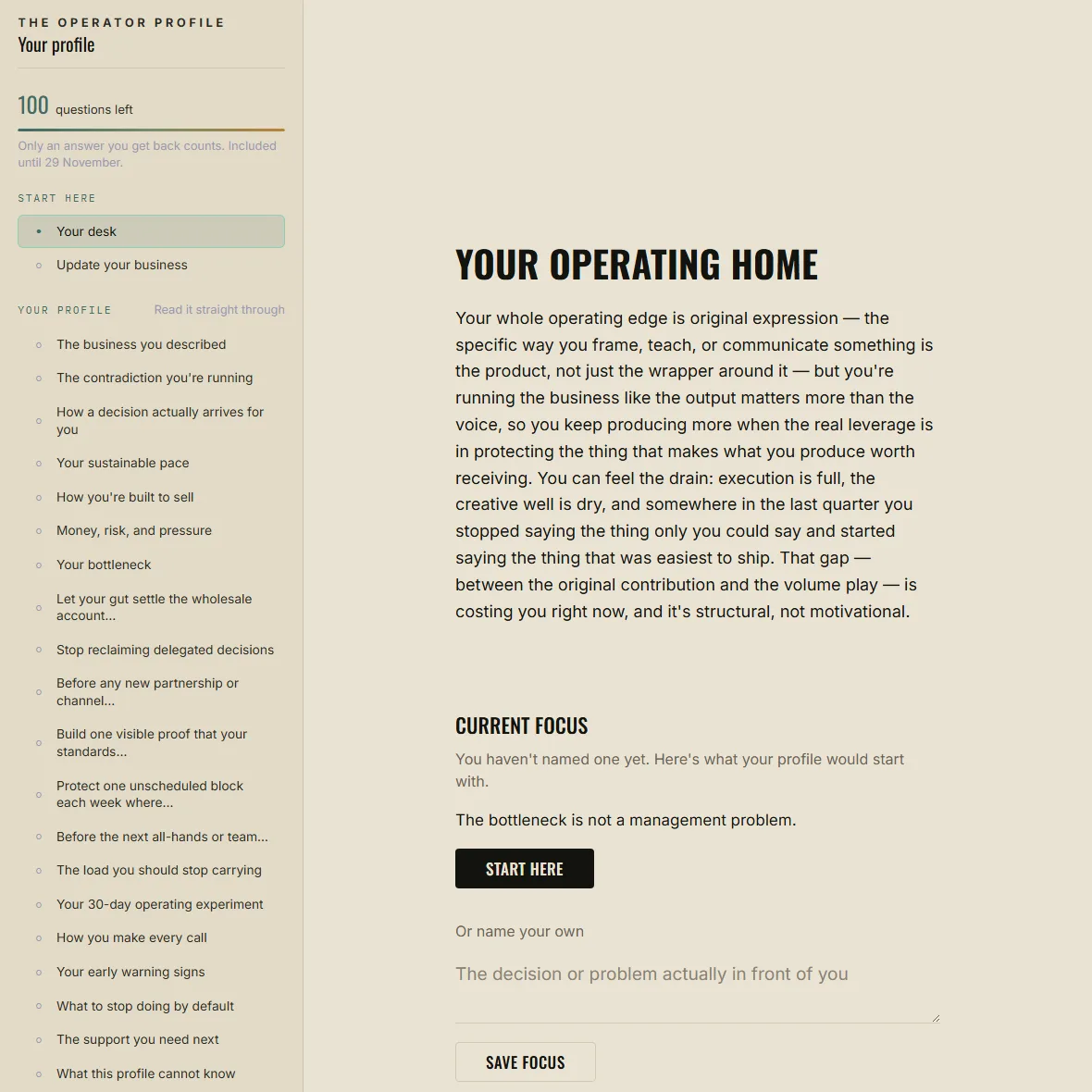
Your operating home. Every section in the rail, the practices under it, and the ask bar pinned to the bottom of every screen.
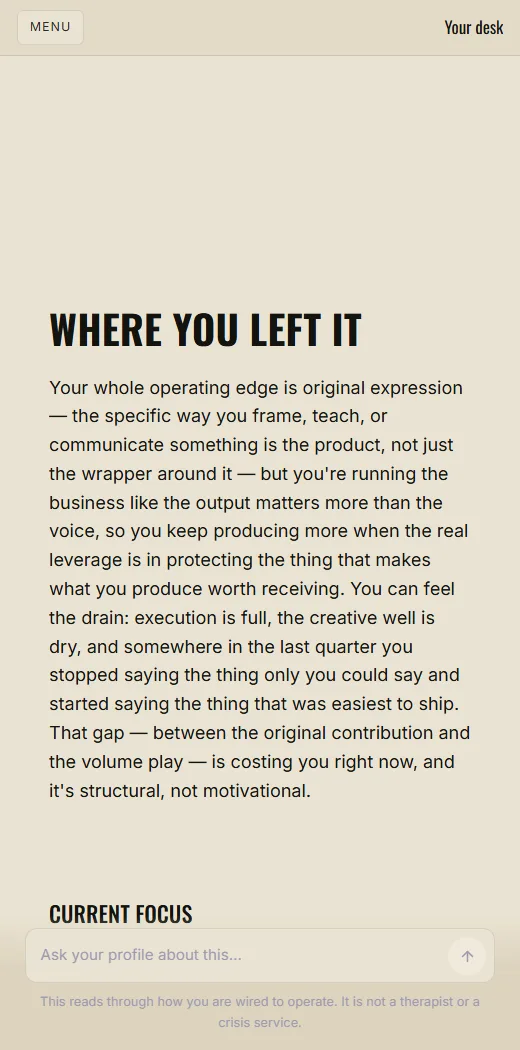
And on a phone, where most people actually read it.
The six practices
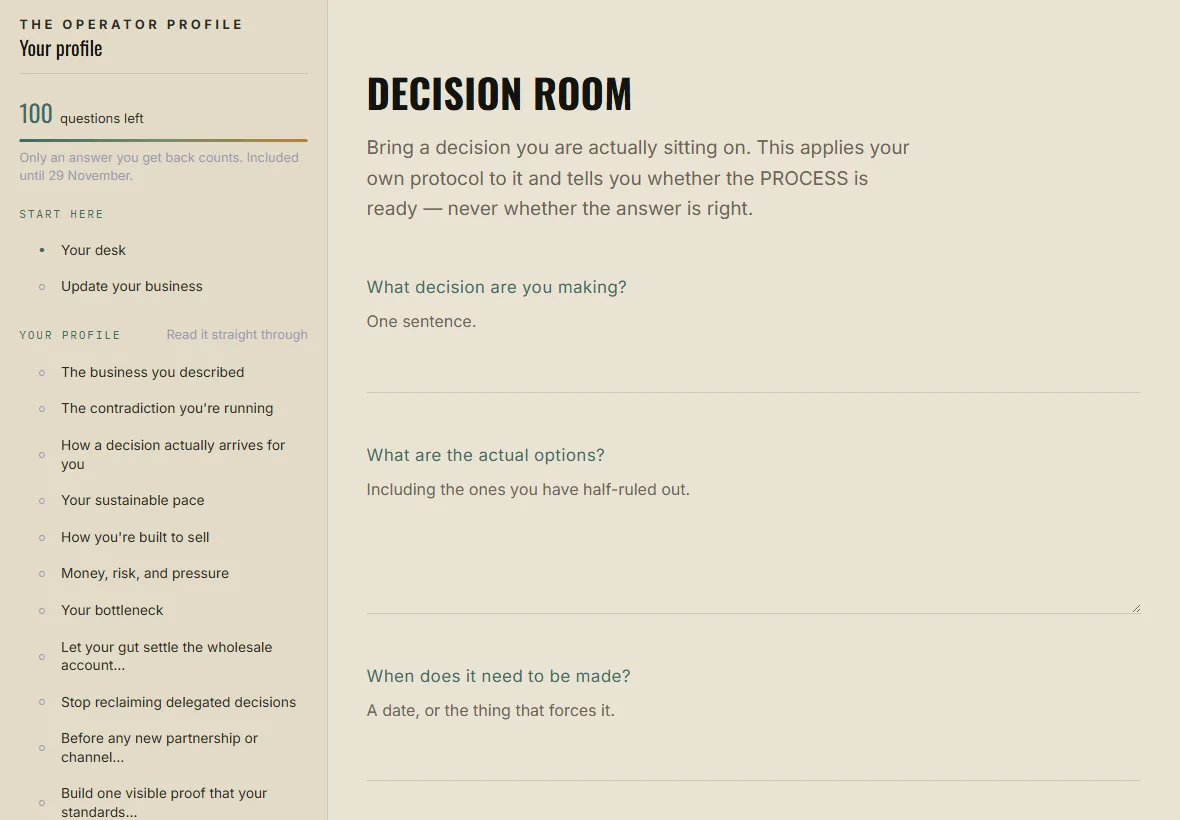
Decision Room
Bring a decision you are actually sitting on. It applies your own decision protocol to that specific call and gives you a brief: the process to use, the self-sabotage pattern to watch for, the business facts it cannot see, and a readiness call about the process, never about which option is right. Afterwards you record what happened, and that becomes part of what it knows about how you really decide.
Bottleneck Lab
Something is stuck. This separates the visible problem from the operating pattern underneath it and leaves you with one experiment worth seven days: the pattern, the early tell, the smallest change worth testing, what to measure, and when to come back.
Weekly Operator Review
Ten minutes on the week that just happened. Which decision took too long, what you kept doing that someone else could have owned, where the week felt clean, where you overrode your own protocol. No streaks, nothing to keep up, no penalty for skipping it for a month.
Delegation Lab
List what you are carrying. It sorts the work into keep, hand off, systemise first, automate carefully, and stop, then builds the actual handoff for the one you pick, including the way you are most likely to take it back.
Build My Week
You give it the hours you actually have, not the hours a productivity book assumes. It returns a week shaped like the way you work: two or three focus blocks placed where they belong for you, decision time matched to your own protocol, recovery where your judgement needs it, one block nothing is allowed into, and a Friday review. It writes a plan you copy. It does not touch your calendar.
Advice Fit Lab
Someone told you to run your business a particular way. This works out which parts fit how you are built, which parts fight you, which parts need business evidence it does not have, and what to modify rather than abandon.
And you can ask it things
An ask bar sits at the bottom of every surface, and it already knows which page you are standing on, so you never have to re-explain your context. Ask what a section means for a specific call this week, or why a particular instruction is aimed at you and not at someone else. It answers in the same operating terms as the document, not as a chat assistant that happens to have read it.
Asking is included: 100 questions across your first 90 days, which is more than most founders get through. If you run out and want to keep going, you can add more from inside the portal. The profile, the portal and everything you have written in it stay yours either way.
If the business changes, you change the six answers. The profile is being applied to whatever you say it is, and you are not asked those questions from scratch ever again.
A document you agree with changes nothing. This is the part that puts it into a week.
Thirteen sections and six practices is a lot to be handed at once, and the ordinary result of being handed a lot at once is that you read the first section, feel understood, and close the tab. So the portal opens on a path instead: six phases, each one a short list of moves, each move a link straight to the thing that does it.
It moves with the calendar and it does not chase you. Nothing is scored. There is no streak to keep, no percentage complete, and no page that tells you that you are behind — if you disappear for a fortnight the path is exactly where you left it, because a founder who missed a week does not need a scolding, they need to know which move is next.
Day 0
Read the map
Three things, in one sitting. Read the contradiction you are running. Pin how you make every call. Name the one thing you are working on this month, in your own words, which every later phase gets pointed at.
Days 1–7
Observe before fixing
The week where you change almost nothing on purpose. Learn your early warning signs and catch one happening. Ask your profile about a situation that is live right now. Start one small experiment. Run your first weekly review. The point of the order is that you cannot tell what is broken until you have watched yourself run for a week.
Days 8–14
Make one cleaner call
Bring a decision you are genuinely sitting on through the Decision Room, using your own decision protocol rather than a generic framework. Then, after you act, debrief it: what you chose, how you knew, what actually happened. That debrief is the single most valuable thing you will record all month, and it is what the review at the end reads hardest.
Days 15–21
Release one piece of work
Take the responsibility inventory, sort what you are carrying into keep, hand off, systemise, automate and stop — then actually hand one thing over, with the handoff written and the route by which you are most likely to take it back already named.
Days 22–28
Rebuild one operating week
Build a week shaped like how you actually work, from the hours you actually have. Take one piece of outside advice you have been carrying and test it against your wiring, keeping the parts that fit. Then run another weekly review, four weeks after the first, which is the comparison that makes the pace question answerable.
Day 30
The Operator Review
The month, read back to you. It opens at day 28, or as soon as you have worked through the phases if you move faster than the calendar does.
At day 30 it reads your own month back to you
Written from what you actually recorded — not from how long you have had it open.
Eight parts. What your profile predicted about you. What you said was true in your own reviews. What your experiments actually showed. The place those three disagree. What you genuinely released and what you only talked about releasing. What is still unfinished. What to carry into the next thirty days, and what to drop.
It refuses to write over an empty month. If nothing was recorded there is nothing to read back, and it says so rather than producing a page of encouragement — which would be worth less to you than an honest blank.
The part that matters: it is allowed to conclude your profile was wrong
We tested that deliberately before shipping it. We seeded a month designed to trap flattery: a profile that claimed this founder's clarity arrives immediately and physically, and a recorded debrief saying the exact opposite — no body signal at all, four days of going back and forth, and a first instinct that turned out to be wrong.
“The profile's account of how your best decisions arrive does not match what you actually observed this month. That is not a small discrepancy. That stands.”
From a real generated Operator Review, on the seeded month described above.
In the same run it recorded that nothing had genuinely been handed off that month, even though the delegation practice had been completed — the naming happened, the change did not. And it did not invent a single detail about the two practices that were never opened.
That is the whole reason the review is worth reading. A tool that can only ever confirm itself is not telling you anything. This one reads your evidence against its own claims, and where they disagree it says so and leaves the disagreement standing for you to settle.
About four minutes of your input. The rest happens on the page while you watch.
STEP 01
Pay $29. There is no account to create first and no call to book.
STEP 02
Enter your birth date, exact birth time and birthplace. If you do not know the time, say so — it will not guess one, and it tells you what it left out because of that.
STEP 03
Answer six questions about the business. One per screen, about three minutes, and you are never asked for your revenue.
STEP 04
Watch it write. Four readings are calculated and interpreted separately, then your profile builds section by section on the page in front of you.
STEP 05
The portal opens and stays. Every section in a rail, the six practices, the 30-day path, and an ask bar at the bottom of every screen.
STEP 06
Work the path, then read the month back. One move at a time to day 30, when the Operator Review tells you what actually held.
If the business changes in month three, you change the six answers from inside the portal and the profile is applied to whatever you say it is. You are never asked those questions from scratch again.
Four cards short enough to pin above a desk
The end of the document collapses into things you can read in ten seconds on a bad morning, without rereading the section they came from.
How you make every call
Your early warning signs
What to stop doing by default
The support you need next
What this profile cannot know
Here is the edge of what your birth data and six business questions can see. Knowing where that edge sits is the only reason to trust what's inside it.
Outside the edge
Whether a market wants what you're selling
Whether your price is right
Whether your unit economics work
Which niche would be the most profitable one for you
Whether to hire, keep, or let go of a specific person
Whether the decision you're weighing will succeed
What you must do
Those are settled by evidence: your numbers, your customers, and the people actually in the room with you. Where a question needs business data the profile doesn't have, it says so and names the data you'd need, rather than dressing a guess up as an answer.
Inside it
How you take information in, and whether clarity arrives in a moment or over a few days
What conditions distort a decision you'd otherwise make cleanly
Where your best output comes from, and what drains it fastest
How you sell when you're not forcing it, and how your voice changes under pressure
Where the way you're built is rubbing against the way you're currently running things
Which of those tensions is worth testing in the next seven days
That's a narrow lane, and it's narrow on purpose. Inside it the profile gets specific, because it's applied to what you sell, how customers find you, what feels heaviest right now, and the decision you named.
You don't have to take that boundary on faith from a sales page. The profile draws it itself, in its own final section. From the real sample:
What you just read knows how you're wired to operate. It does not know whether a market wants what you're selling. That is a question your numbers answer, not your birth data. […] Every one of those things is settled by evidence: your market, your numbers, the people actually in the room with you.
The company is yours. The call is yours. Nothing written here outranks your own judgement about your own business.
That's the arrangement. You get better information about the operator; you stay the one who decides what the business does with it. If a line in there doesn't match what you see in your own week, throw it out. The profile hands you its instructions as experiments for exactly that reason, and tells you what to watch so you can settle it yourself.
Who the Founder Advantage Blueprint is for
You are already running something. There is revenue, there are customers, and a week that fills itself.
That is the starting condition: the profile applies how you are built to a business that already exists, so there has to be one. Past that, it is written for you if any of this is true.
The business works, but only because you keep overriding your own pace or your own way of deciding.
Advice that visibly works for other founders keeps failing to stick for you.
You are sitting on a decision you understand completely and still cannot make cleanly.
Selling, being visible, or handing work off keeps costing more than it should.
You suspect you are the bottleneck, and you cannot see the exact mechanism.
You want something you can act on this week, not another label for the pile.
The profile reads your six answers straight back to you before it applies anything. Here is that moment from a real generated profile:
Strategic advisory retainers sold to founders of small agencies, plus a self-serve digital product. Right now the business is you alone. Clients find you through referrals and through content you put out.
If you do not have answers to those questions yet, there is nothing for the profile to be applied to.
And who it is not for
Here is what it will not do. Better you find that out now than after you pay.
It will not write your business plan, and it will not build your marketing strategy. It will not pick a niche or rank your options by which one pays best. It will not name a dream client. It will not tell you whether your price is right, whether your unit economics work, or whether the market wants what you sell, because those are settled by your numbers and not by your birth data.
It will not forecast. Nothing in it predicts revenue, growth, or how a decision turns out. The profile says so itself, in its own closing section: it does not know whether a particular decision you are weighing will succeed or fail, and it does not tell you what to do.
And it is not a horoscope. No month ahead, no good days and bad days, no daily guidance. Your birth data is read once, for how you are built to operate, and everything after that is about how your week actually goes.
If you wanted one of those, this is not it, and I would rather you kept your $29. If you wanted a straight read on why the way you run the business keeps fighting the person running it, that is the whole document.
Nobody has reviewed this product yet
A page like this normally has a wall of screenshots by now. There is not one here because the Founder Advantage Blueprint in this form is new. When there are real reviews — with names, with permission, from people who ran the path and read their own review — they will go here, and not before.
So the substitute is the product. The opening lines of a real generated profile are further up this page, copied out of the file exactly as produced. So is a complete operating instruction with all six of its fields, and a passage from a real Operator Review disagreeing with the profile that produced it. Those were all generated by the thing you would be buying.
The price is $29. The written profile, portal, six practices, 30-day path, day-30 review, and first 100 questions are included.
Who made this
I am Brandon Huston. I built The Spinsterz from the ground up inside flow arts and festival culture, ran it for roughly eighteen years, grew it into a seven-figure business, and eventually sold it.
Eighteen years is long enough to make every mistake in this document personally. I ran on override for most of them. I built the time-blocked schedule more than once and quietly stopped setting the alarm. I kept work I should have handed off, on the reasoning that it was faster to do it myself than to write the instructions — a sentence you will meet again inside the Delegation Lab, which is in there because it was mine first.
What came after that chapter is why this exists. I kept building businesses, and I got much more interested in why people make the decisions they make — including why I had spent years overriding calls I had already made correctly in the first ten seconds. The things that finally explained that to me were not business tools. They were readings of how a person is built: Human Design, the I Ching, and the Western and Vedic charts, treated as one map rather than four hobbies. The problem was that nobody had ever pointed one of them at a Tuesday.
That is the whole of what the Founder Advantage Blueprint is. Those readings, aimed at the operating problem, written in the language of running a company instead of the language of the systems they came from.
Building one seven-figure business does not make me right about yours.
It makes me one operator, with one set of wiring, and eighteen years of evidence about what that particular wiring costs when you ignore it. Which is exactly why none of this is built on my opinion of your business. It is calculated from your birth data, applied to the six answers you give about the company, and every instruction in it is written as an experiment with an observable signal — so your own week gets the last word, not me.
Somewhere in the middle of all that I started describing the job as professional fun-haver. It is not a joke about being unserious. It is the actual target: fewer weeks spent forcing yourself through work you were never built to do, and more of the business spent on the part you would have done anyway.
The founders who come to me have usually already built the thing. The business works. They do not — not the way they should. They are running something real, and somehow it is still running them. That gap is the only thing I look at, and this is the version of it you can buy for $29 instead of booking me.
Astrology is two of the four things it reads: the Western chart and the Vedic chart. The others are Human Design and the I Ching. But nothing in the document names any of them, and it is not written in that register. It is written as an operating manual. If a section only worked because you believed in the source, it would not be worth $29. Read it and see whether it describes how you actually work.
What if I don't know my birth time?
Then it will not guess one. A birth time changes the read substantially, so instead of inventing a plausible time, the system calculates your chart across the window you give it and keeps only what stays the same throughout. The time-sensitive parts are left out and said to be left out. A smaller true profile beats a complete invented one.
Do I have to answer the business questions?
No. The profile still generates. But the instructions get noticeably less specific, because there is nothing to aim them at, and the section that reflects your business back is simply omitted rather than filled in with a guess. Three minutes is a good trade.
How long is it?
Longer than you will finish in one sitting. The sample we generated runs to roughly fifteen printed pages, and that is the floor rather than the figure. It is built to be returned to on the week the section applies, not read once. Keep the link it gives you. That link is how you get back in.
What does $29 include?
Your thirteen-section profile, five to seven operating instructions, six practices, 30-day path, day-30 Operator Review, the portal you keep, and 100 questions across your first 90 days. More questions after the included allowance are optional.
Is this a subscription?
No. $29 buys the document and the portal, and they do not expire. Asking the strategist is included for your first 90 days, up to 100 questions. If you want to keep asking after that, there is an optional $9 a month, or you can buy questions in a batch without any plan. Neither is required, and nothing you already paid for is taken away if you skip both.
Can this help me build a $10,000-a-month business?
$10,000 a month can be the target you bring to the work. The Founder Advantage Blueprint cannot tell you whether the market wants your offer, whether your price is right, or whether the business will reach that number. It helps you test how you make decisions, sell, structure your week, delegate, and handle pressure while you build toward the target. The result still comes from your customers and your business numbers.
What is the 30-day path?
Six phases from day 0 to day 30 that turn the document into a sequence of single moves: read the contradiction and set your focus, then a week of observing before fixing, then one cleaner decision, then one real handoff, then a rebuilt week, then the review. Every move is a link to the page that does it. It is included, it opens when your profile does, and nothing is scored.
What if I fall behind the path?
Nothing happens. There is no streak, no percentage complete, and no page that tells you that you are behind. Come back after three quiet weeks and the path is exactly where you left it, with the next move still the next move.
What happens at day 30?
The Operator Review reads your month back in eight parts, written only from what you actually recorded. It will name the place your own evidence contradicts your profile and refuse to resolve it in the profile’s favour — we tested exactly that before shipping it. If you have recorded nothing, it declines to write rather than filling an empty month with encouragement. It opens at day 28, or earlier if you work through the phases faster than the calendar.
Can I change my business answers later?
Yes, any time, from inside the portal. Businesses change in month three. You should not have to buy a second profile to say so.
What if it doesn't describe me?
Then say so. It is a read of tendencies, not a measurement, and it can be wrong about a person. The practices are built to notice that. The Weekly Review is explicitly allowed to conclude that a hypothesis in your profile did not hold. A tool that can never be wrong is not telling you anything.
Will it tell me what to do with my business?
No, and it says so in its own last section. It cannot know whether a market wants your offer, whether your price is right, whether the unit economics work, which niche is most profitable, whether to hire or fire someone, or whether a decision will succeed. Those need business evidence it does not have. What it can do is show you how you are built to operate and where that is costing you.
Who is behind this?
Brandon Huston. I built The Spinsterz from the ground up, ran it for roughly eighteen years, grew it into a seven-figure business and sold it, and I have been building businesses since. The longer version, including why that does not make me right about your business, is further up this page.
How is this different from a coach?
A coach learns how you work through conversation. The Founder Advantage Blueprint starts with a read of your operating patterns and gives you practices to test those patterns against the business. It is not a replacement for someone who knows your market, your customers, and your numbers.
What is “Ask your profile”?
A strategist that has read your document and answers in its terms. It sits at the bottom of every page in the portal and knows which page you are on. It is not a therapist and not a crisis service, and it will say so if you take it somewhere it should not go.
Is my data private?
Your birth data and business answers are used to generate and operate your profile, and the app stores them so you can return to your portal. You can export or delete your profile data using buttons inside the portal. Tracking choices for this public sales page are separate and optional.
Do I need to believe in any of this?
No. The document never asks you to. It describes how you operate and hands you instructions you can test inside seven days, and every instruction comes with what to watch, so you can find out whether it was right rather than deciding whether to trust it.
Every other one stops at what you are
It gave you a type, a number, a letter. It held your attention for a day. Then Monday came and nothing about how you run the business changed, because nobody told you what to do with it.
That is the whole difference here. The Founder Advantage Blueprint spends its first half on recognition: the contradiction you are running, how a decision actually arrives for you, the pace you can hold, how you are built to sell, what money and pressure do to your judgement, and where you have become the bottleneck. Then it turns and spends the second half on what to do about it, inside the business you described, starting this week.
Enter your birth date, birth time if you know it, and place. Answer the six questions about the business. Then read the first section and hold it against a real Thursday in your actual week. If it is not true of you, stop there. If it is, the rest of the Founder Advantage Blueprint was written for that person — and the thirty days after it exist to get the thing into the week rather than into your notes.
$29. The path, the review and the first 100 questions are included.
What arrives
A written profile in thirteen sections, built from your data and handed to nobody else.
Five to seven operating instructions, each carrying why it fits you, where it shows up in your week, what ignoring it costs, an experiment you can run inside seven days, and the signal to watch.
A 30-day operating experiment that sequences the three with the most leverage.
Four pin-it-up cards, and a section stating plainly what the profile cannot know.
A portal you keep, with every section in a rail and six practices that run your profile against a real decision, a real handoff and a real week.
The 30-day path, which turns all of it into one move at a time, and never tells you that you are behind.
The Operator Review at day 30 — your month read back, including where your own evidence contradicted the profile.
100 questions across 90 days to a strategist that has read your document and knows which page you are on.
The Founder Advantage Blueprint · $29 · Brandon Huston
It reads how you are wired to operate. It is not financial, legal, or medical advice, and it does not predict outcomes.